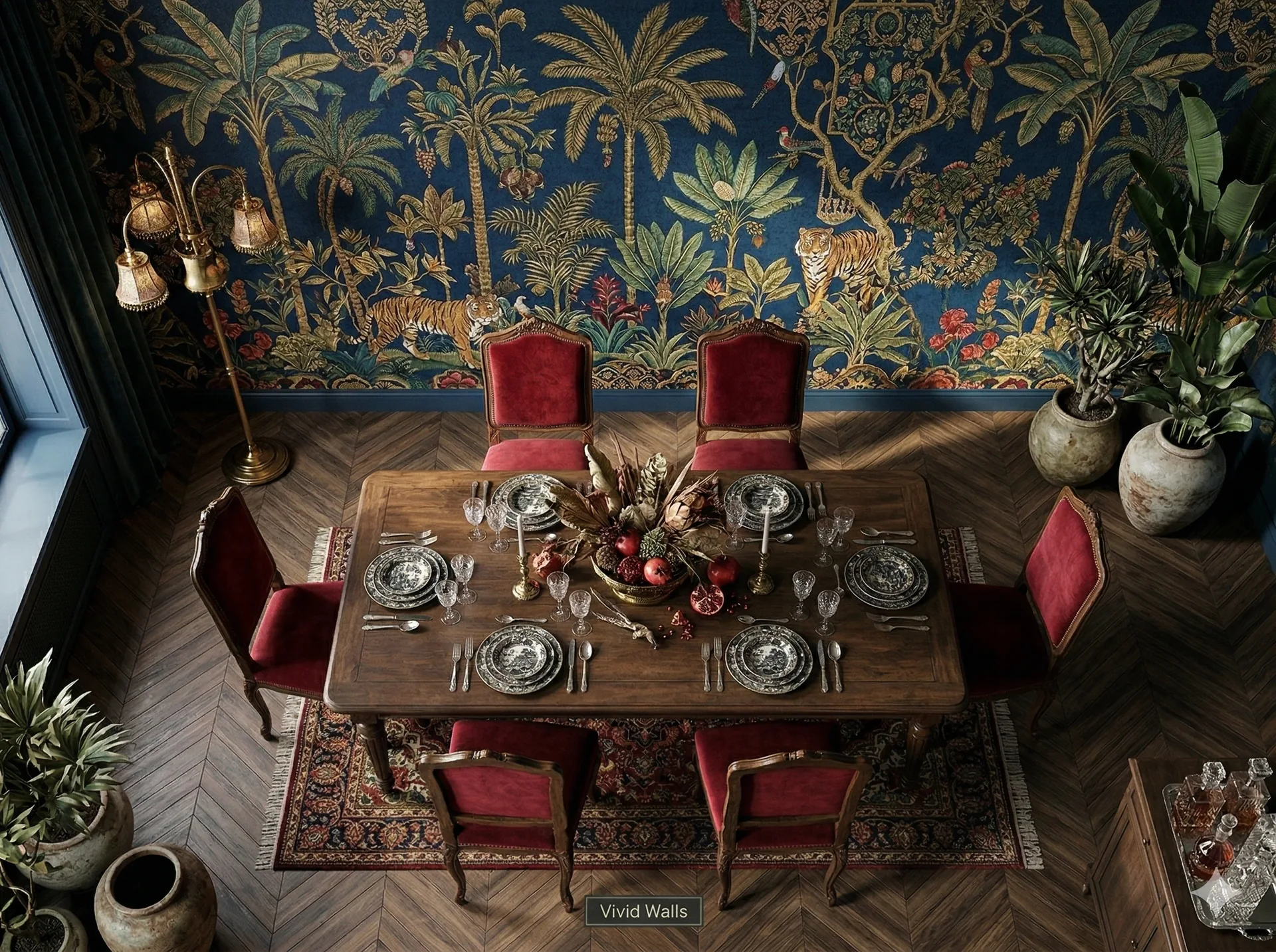
A feature wall is the single most impactful change you can make to a room without a full renovation. The right wallpaper on the right wall changes the scale, mood, and personality of a space entirely — and because custom printing removes the constraints of off-the-shelf rolls, the wall can carry any image, texture, or pattern at any dimension. Here are seven ideas that consistently deliver results, from calm residential interiors to high-traffic hospitality environments, each paired with the substrate that makes it work.

1. Panoramic landscape mural

A full-width landscape — forest, mountains, coastal horizon — printed across a single wall creates a sense of depth that no paint colour can replicate. The key is scale: size the image to fill the wall completely, with no borders or margins, so the effect reads as a window rather than a poster. This is where custom printing earns its keep, because the mural is produced to your exact wall dimensions rather than cropped from a standard roll. Specify a matte non-woven substrate to avoid reflections that would break the illusion; the smooth 250 g/m² Andromeda texture keeps fine photographic detail crisp, while the linen-effect Crux adds a canvas-like softness to painterly scenes. Non-woven’s dimensional stability matters here too — a horizon line running across three or four butt-joined drops must meet perfectly, and a fleece backing that neither stretches nor shrinks during hanging is what guarantees it does.

2. Architectural texture on a single wall

Not all feature walls need a printed image — a heavily embossed non-woven wallpaper adds tactile depth that paint cannot achieve, even in a single restrained colour. The VIVID WALLS Nonwoven collection carries twelve embossed textures designed for exactly this application: Vela reproduces leather grain, Fornax a crumpled-paper relief, Orion a fine diamond mesh, Phoenix a coarse crushed effect, and Sculptor clean vertical stripes. The relief patterns are deep enough to read at interior scale — shadows shift across them through the day — without overwhelming the rest of the room. For high-traffic settings, move up the weight classes: the 350 g/m² Auriga carries a heavy woven texture that doubles as impact protection in corridors, and the 450 g/m² Taurus adds a no-scratch surface for walls that get cleaned or brushed against daily. Texture walls suit minimalist interiors where a printed image would feel like noise but flat paint feels unfinished.

3. Bold geometric pattern behind a bed headboard

The wall behind a bed is the natural focal point of a bedroom, and a large-scale geometric pattern anchors the space and frames the bed as the centrepiece. Scale the geometry to the wall, not to a sample swatch: a motif that looks bold on a 30 cm printout can dissolve into visual static across four metres, so as a working rule keep repeating elements at least 20–30 cm across. Keep the palette relatively monochromatic so the pattern complements rather than competes with bedding, curtains, and furniture — two tones of the same hue photograph particularly well in hotel marketing imagery. For residential bedrooms, any 250 g/m² texture works; for hotel rooms, where housekeeping wipes walls between stays, specify the Heavy (350 g/m²) or No-Scratch (450 g/m²) non-woven variants. The washable vinyl surface takes routine cleaning without dulling the print — a specification detail that saves refurbishment budgets years later.

4. Abstract art scaled to the wall

Original artwork scaled to wall dimensions — abstract brushwork, ink wash, botanical illustration — turns a feature wall into a gallery piece. The advantage over framed art is seamless coverage: no frame lines, no white borders, just the image from floor to ceiling across the full wall width. The advantage over a stretched canvas is scale, since a wallpaper mural is not limited by stretcher-frame dimensions. That said, the two formats work together: many of our interior design clients pair an abstract mural on one wall with coordinated canvas prints elsewhere in the space (Canvas prints) to carry a palette through a project. Abstract murals are particularly effective in sitting rooms, offices, and boutique hotel rooms, where they give a space identity without the literalness of photography. Supply artwork at print resolution or commission it — then order the mural to measure (request a quote) so composition lands where the wall needs it.

5. Dark moody backdrop for a home office

A deep, dark feature wall — navy, forest green, charcoal — behind a desk creates a focused, professional backdrop and signals that the home office is a serious working environment. It also performs on camera: on video calls, a dark textured wall reads as considered and calm where a blank white wall reads as provisional. A printed texture in these tones — brushed dark fabric, dark concrete, the vertical-thread Lacerta or fine-grain Pictor embossing under a deep colourway — adds depth without feeling flat. For homeowners, washable 250 g/m² non-woven is the natural choice and strips off dry when the room changes role. For rented spaces, self-adhesive PVC film is the practical route: it applies to sound painted walls without paste and removes cleanly, though its natural sheen means a matte laminate is worth specifying for a wall that faces a window or a ring light.

6. Branded wallpaper in a commercial environment

For retail, hospitality, and corporate spaces, a feature wall embeds brand identity into the physical environment in a way that photography and signage cannot replicate — brand colours, patterns, or a supergraphic become the architecture itself. Reception walls, lift lobbies, restaurant interiors, and meeting rooms are the classic applications; a custom repeat pattern built from a brand mark is subtler and longer-lived than a logo wall. The non-negotiable here is compliance: commercial projects must specify fire-rated substrates, and this is where material choice is decided by regulation rather than aesthetics. The VIVID WALLS Nonwoven collection is M2 certified, and the HP PVC-Free Wallpaper carries B1 (Germany) and M1 (France) ratings with FSC®, CE, and GREENGUARD certification — the specification for public buildings, schools, and healthcare. Our comparison guide explains which rating applies where (Self-adhesive vs non-woven wallpaper), and certificates ship with commercial orders.

7. Repeat pattern in a bathroom or kitchen

In bathrooms and kitchens, a well-chosen repeat pattern on the feature wall adds interest without the cost and permanence of real tiles — and it can be replaced for a fraction of the price when the scheme dates. This is the one room category where the substrate decision is made for you: specify self-adhesive PVC film, which is purpose-made for moisture environments. The 80 µm monomeric vinyl is water-resistant, wipeable, rated from −45°C to +82°C, and its permanent adhesive bonds to smooth non-porous surfaces — including existing tiles, which makes it a genuine renovation shortcut. The naturally glossy finish suits these rooms, echoing glazed ceramic; a matte laminate is available where you want a softer look. Keep the pattern scale proportionate to the wall: small motifs in compact cloakrooms, larger repeats where there is room to breathe. Avoid areas of prolonged direct water jet — behind a sink is fine, inside a shower enclosure is not.

Getting the most from your feature wall

The single most important decision is substrate selection, and the rule is to match the material to the environment rather than to the image. Non-woven fleece is the default for permanent residential and hotel installations: matte, breathable, dimensionally stable across multi-drop murals, washable, and M2 fire certified. Self-adhesive PVC handles the exceptions — moisture, non-porous surfaces, temporary and rented spaces. HP PVC-Free covers commercial projects with strict fire and emissions requirements. Everything we print is produced to measure, so start from your wall dimensions, not from a catalogue size; the full material line-up is on the wallpapers page (Designer wallpapers), and the deeper material guide explains the non-woven range in detail (What is non-woven wallpaper?). If you are working on a client project, the VividWalls team works directly with interior designers and hospitality clients across the EU — send dimensions and a design brief for a quote (request a quote).

Frequently asked questions

Which wall should be the feature wall?

Choose the wall the room naturally faces: behind the bed in a bedroom, behind the sofa or opposite the entrance in a living room, behind the desk in an office. Avoid walls broken by doors, windows, or radiators — a feature wall works best as one uninterrupted plane.

Does a feature wall make a room look smaller?

Generally the opposite, if the content suits the space. A panoramic landscape adds perceived depth, and vertical textures such as Sculptor or Lacerta draw the eye upward, raising the ceiling visually. Very dark or dense patterns can compress a small room — in compact spaces, favour depth-creating imagery over heavy repeats.

How much does feature wall wallpaper cost?

Custom-printed wallpaper is priced per square metre, which is why it is quoted from your wall dimensions rather than sold by the roll. Material choice (non-woven weight class, PVC film, or HP PVC-Free) sets the rate. Send measurements for an exact quote (request a quote).

Can I put a feature wall mural over existing paint?

Yes, if the paint is sound, clean, and dry. Non-woven hangs with PVA adhesive over primed painted walls; glossy paint should be keyed with light sanding first. Self-adhesive PVC bonds well to sound painted surfaces but will pull away flaking or chalky paint — always test a corner.

What image resolution does a wall-sized mural need?

As a manufacturer guideline, supply the largest original file you have — murals are viewed from a distance, so effective resolution requirements are lower than for close-up print. We check every file against the ordered dimensions before production and tell you honestly if it will not hold up at wall scale.