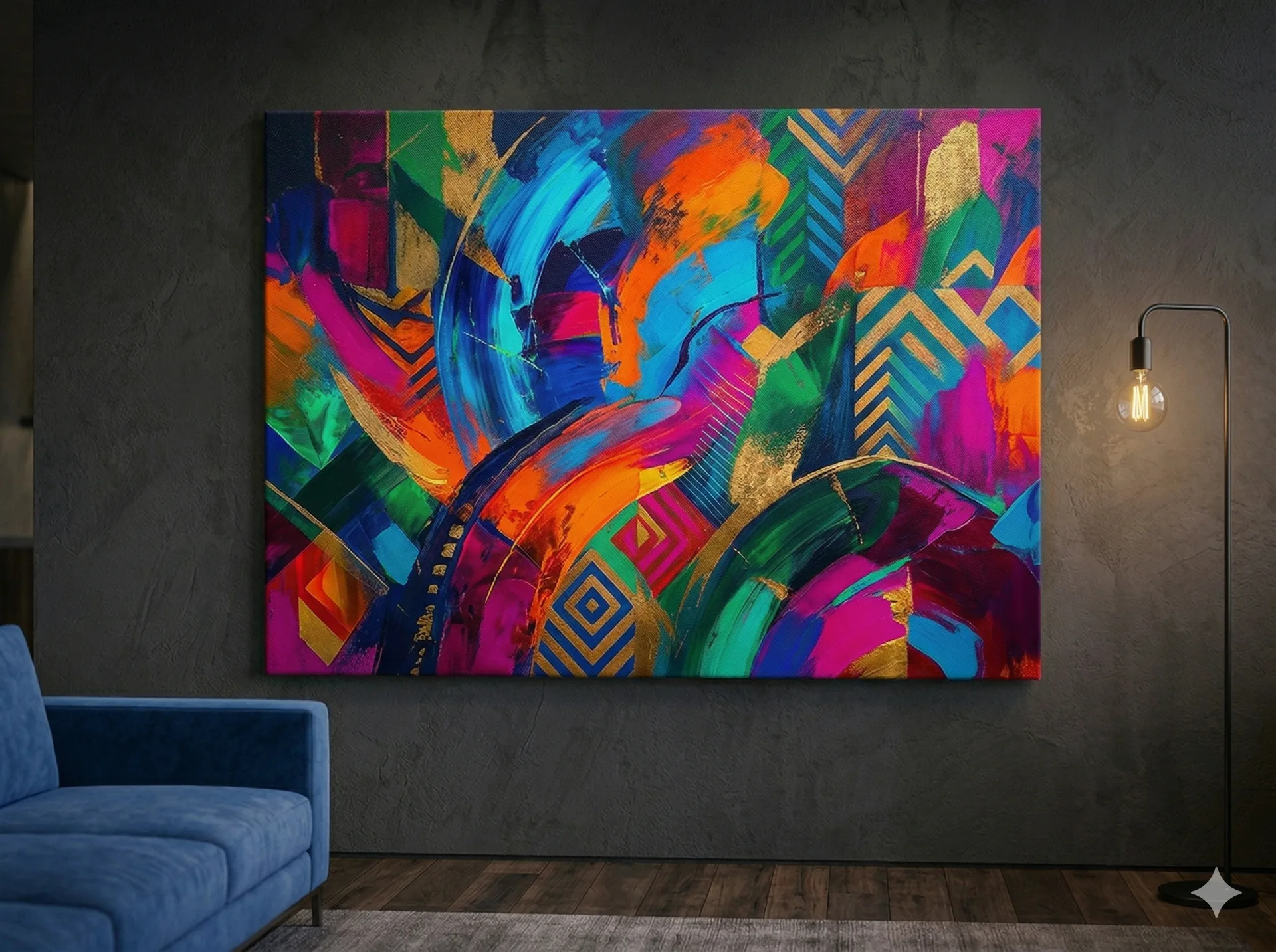
Every canvas print we produce starts with the same question, answered before a single drop of ink goes down: which fabric? We print on three — 100% polyester, a 50/50 cotton-polyester blend, and 100% cotton — and the choice affects the finish, the maximum size, the surface character, and the price of the final piece. Online advice on this topic is mostly written by resellers repeating each other; this comparison is written from the production floor, using the actual specifications of the three fabrics on our machines. The honest summary up front: there is no universally superior canvas, only a right canvas for a given image, budget, and setting.

What is the difference between cotton and polyester canvas?

The difference is the fibre, and everything else follows from it. Cotton is a natural fibre: it takes ink deep into the thread, produces a matte surface with visible woven texture, and is the material of traditional artists’ canvas — which is why galleries and fine-art reproduction default to it. Polyester is a synthetic fibre: smoother, more uniform, and dimensionally very stable, it holds ink nearer the surface, which yields slightly punchier colour and a light sheen. Weight tells the same story in numbers: our 100% cotton canvas weighs 370 g/m², our 100% polyester 270 g/m², and the 50/50 blend sits between them at 300 g/m². Heavier natural fabric drapes and tensions like a gallery object; lighter synthetic fabric is easier to produce at scale and friendlier to project budgets. Neither is a compromise on print quality — both run the same eco-solvent inks through the same production line in Sofia.

The three canvas fabrics we print on

Our canvas line-up covers the full span from volume-friendly to gallery-grade, and all three fabrics are printed with eco-solvent inks for interior use:

  • 100% Polyester — 270 g/m². A smooth, slightly glossy surface on rolls of 1067 and 1600 mm. The workhorse fabric: crisp detail, vivid colour, the most economical of the three, and the standard choice for commercial volume work.
  • 50% Cotton / 50% Polyester — 300 g/m². A matte surface on 1067 mm rolls. The blend pairs cotton’s texture and finish with polyester’s stability and price point — the pragmatic middle of the range.
  • 100% Cotton — 370 g/m². A heavyweight matte fabric on 1067 and 1600 mm rolls. The premium option: true artist-canvas texture, the deepest matte finish, and the largest maximum print width.

All three stretch over the same five spruce/fir profiles, from the stocked №1 Standard (20×37 mm) to the large-format №3A Statement (40×45 mm) — profile guidance is in the sizing guide (Canvas print sizing guide).

Comparison table

Property100% Polyester50/50 Blend100% Cotton
Weight270 g/m²300 g/m²370 g/m²
Surface finishSlightly glossyMatteMatte
TextureSmooth, uniformModerate weavePronounced natural weave
Roll widths1067 / 1600 mm1067 mm1067 / 1600 mm
Max stretched width142 cm~100 cm (roll-limited)160 cm (170 cm partner)
Colour characterVivid, high-contrastBalancedSoft, fine-art depth
Relative priceMost economicalMidPremium
Typical useVolume, commercial, photographyHomes, offices, mixed briefsGalleries, fine art, statement pieces
InksEco-solvent, interior useEco-solvent, interior useEco-solvent, interior use

When to choose polyester canvas

Choose 100% polyester when colour impact, budget, or quantity leads the brief. The smooth 270 g/m² surface renders fine detail without the interruption of a heavy weave, and its light gloss lifts saturation — qualities that flatter contemporary photography, bold graphic art, and brand imagery. It is the fabric we recommend for commercial volume: hotel room sets, office floors, retail programmes, and reseller catalogues, where dozens or hundreds of pieces must match exactly and unit economics matter. Polyester’s dimensional stability is an underrated production virtue here — it tensions predictably on the stretcher, piece after piece, which is precisely what a 40-room hotel order needs. Its limits are aesthetic rather than technical: the sheen that energises a vivid photograph can look thin on a reproduction of an oil painting, and under strong directed lighting the gloss shows reflections a matte fabric would swallow. Maximum single-piece width is 142 cm; wider walls move to multi-panel sets.

When to choose cotton canvas

Choose 100% cotton when the piece itself is the point — fine-art reproduction, a statement canvas above the sofa, gallery and exhibition work, or a client who will stand close and look. At 370 g/m² it is the heaviest fabric we stretch, and it behaves like it: taut, flat, substantial, with a woven texture that reads unmistakably as artist’s canvas from a metre away. The deep matte surface handles dark tones and subtle gradients particularly well — charcoal drawings, moody landscape photography, and painting reproductions keep their depth instead of flattening under a sheen. Cotton also carries the largest format capability in the range: single pieces up to 160 cm wide, or 170 cm for trade clients through the partner programme, both on the 1600 mm roll. Its costs are the natural ones — the highest fabric price of the three and, as a natural fibre, a preference for stable indoor conditions, covered in the care guide (Canvas care guide).

When the 50/50 blend is the right answer

Choose the 50/50 cotton-polyester blend when you want a matte, textured canvas without the premium of full cotton — which in practice makes it the default recommendation for most residential briefs. At 300 g/m² it carries genuine weight and a moderate weave, enough for the finished piece to read as fabric rather than photo paper, while the polyester half of the yarn keeps tensioning stable and the price closer to polyester than to cotton. Interior designers use it as the project workhorse: a dozen matte canvases across a home or boutique property, consistent in finish, without pushing the art budget into gallery territory. Its one hard constraint is size, since the blend runs only on the 1067 mm roll — single pieces are limited to roughly a metre on the shorter dimension. If the brief calls for a matte canvas wider than that, step up to 100% cotton; if it calls for maximum colour punch at minimum cost, step across to polyester.

Inks, finish and what we don’t print

All three fabrics are printed with eco-solvent inks and specified for interior use — a deliberate production choice, not a limitation we hide. Eco-solvent pigment inks bond into the coated canvas surface, producing a durable, scratch-tolerant image layer with wide colour gamut and none of the strong odour of hard-solvent printing, so a canvas can hang in a bedroom or hotel room straight out of the packaging. Interior specification means what it says: none of the three fabrics is intended for outdoor exposure, direct weather, or unshaded full-sun positions, and a canvas in a steamy bathroom is living a shorter life than it should — placement guidance is in the care guide (Canvas care guide). Finish differences between the fabrics come from the fibre, not from varnishes: polyester’s light gloss and cotton’s flat matte are inherent surfaces. Every canvas is stretched by hand over spruce/fir profiles in Sofia and shipped ready to hang across the EU (Canvas prints).

Frequently asked questions

Is cotton or polyester canvas better for photo prints?

Polyester, in most cases. Its smooth 270 g/m² surface and slight gloss give photographs crisp detail and strong saturation. Choose cotton for photography when you want a fine-art character — soft matte finish and visible weave — particularly for black-and-white or muted-tone images.

What does g/m² mean on a canvas specification?

Grams per square metre — the weight of the bare fabric. Heavier generally means a denser, more substantial canvas: our polyester is 270 g/m², the 50/50 blend 300 g/m², and the 100% cotton 370 g/m². Weight is a build-quality signal, not a print-quality score.

What is the biggest canvas print I can order?

On 100% cotton, single pieces reach 160 cm in width (170 cm via the partner programme); on polyester, 142 cm. Length runs along the roll and is effectively unrestricted. Wider walls are covered with multi-panel sets — see the sizing guide (Canvas print sizing guide).

Are your canvas prints suitable for outdoor use?

No. All three fabrics are printed with eco-solvent inks and specified for interior use. For covered but outdoor-adjacent spaces — conservatories, enclosed balconies — polyester is the more resilient fibre, but direct weather exposure is outside specification for every canvas we make.

Can I order samples of the three fabrics?

Yes — trade clients receive fabric swatches through the partner programme, and we advise on fabric choice for specific images as part of every quote. Send your image and intended size with an enquiry (request a quote) and we will recommend the fabric honestly, including the cheaper one when it is right.