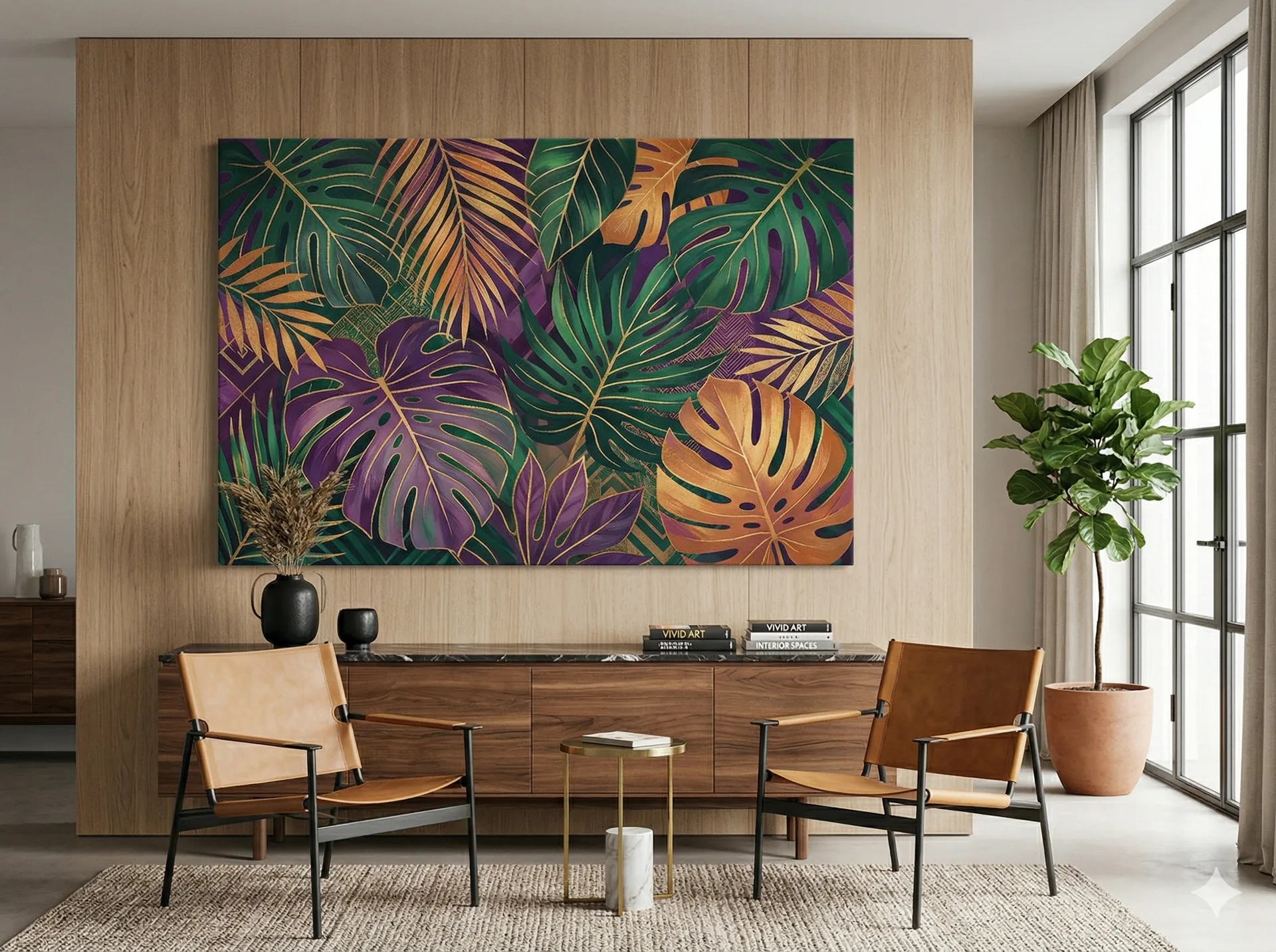
Most canvas prints that disappoint do so for one reason: they are too small for the wall they hang on. The image is right, the print quality is right, but the proportions are wrong — and no artwork survives being marooned in the middle of an empty plane. Because we print every canvas to order rather than to a fixed catalogue, size is a genuine design decision, not a compromise. This guide gives you the working rules we share with interior designers: how to size a canvas to a wall, to furniture, and to a room, when to split an image across multiple panels, and where the physical limits of the material sit.

How do you choose the right canvas print size?

The reliable starting rule is that a canvas should fill 60–75% of the visible wall width it hangs on. Measure the wall — or the section of wall between architectural interruptions such as doors, windows, or shelving — and multiply by 0.6 and 0.75 to get your target range. A 3-metre wall section therefore wants roughly 180–225 cm of artwork width, which at canvas scale usually means a multi-panel set rather than a single stretched print. When the canvas hangs above furniture, the furniture becomes the reference instead of the wall: aim for two-thirds to three-quarters of the width of the sofa, bed, or sideboard beneath it. Anything below half the furniture width visibly floats. Height follows from the aspect ratio of your image, but check the result leaves at least 15–25 cm of clear wall between furniture and canvas bottom edge. Round to the nearest available size last — proportion first, catalogue second.

Standard sizes and what they suit

Standard sizes exist because we hold №1 Standard profile (20×37 mm) stretcher bars in stock in 5 cm increments from 20 to 100 cm, so any combination within that grid — 30×40, 50×70, 80×100 and every step between — goes into production immediately. These stocked formats cover the majority of residential briefs:

Canvas size (cm)Typical placement
30×40 – 40×50Hallways, shelf groupings, gallery wall components
50×70 – 60×80Bedrooms, home office, above a desk or console
70×100 – 80×100Above a two-seat sofa or double bed headboard
100×100 and up (custom)Statement walls, above large sofas, commercial spaces

Treat the table as a shortcut, not a rule — the 60–75% calculation always takes priority over a nominal “living room size”. A compact apartment living room and a hotel lobby both contain sofas, and the right canvas for each differs by a metre. If your target dimensions fall inside the 20–100 cm grid, you get the fastest production route; outside it, we build the frame to measure (request a quote).

How large can a single canvas print be?

The maximum size of a single stretched canvas is set by the roll width of the fabric, and it differs by material. Our 100% polyester canvas (270 g/m²) prints on 1067 and 1600 mm rolls and stretches to a maximum finished width of 142 cm. The 100% cotton canvas (370 g/m²) also runs on 1067 and 1600 mm rolls and reaches 160 cm — or up to 170 cm through our partner programme for trade clients. The 50/50 cotton-polyester blend (300 g/m²) prints on 1067 mm rolls, suiting formats up to roughly one metre on the shorter side. The other dimension of the canvas is effectively free — length along the roll — so a 150×300 cm single-piece cotton canvas is producible, while a 200×200 cm one is not. Above these widths, the correct engineering answer is a multi-panel set. For material differences beyond size, see the canvas material comparison (Cotton vs polyester canvas).

Sizing a canvas to your wall: quick reference

Working from the 60–75% rule, this table converts common wall and furniture widths into canvas target ranges. Measure the visible wall section, not the whole room:

ReferenceWidthCanvas target (60–75%)Suggested format
Narrow wall / hallway end120 cm70–90 cmSingle 60×80 or 70×100 portrait
Double bed (headboard wall)160 cm100–120 cmSingle 120×80, or 2 panels of 55×80
Three-seat sofa220 cm140–165 cmSingle 160×90 cotton, or 3 panels of 50×100
Sideboard / console180 cm110–135 cmSingle 120×80 landscape
Open wall, no furniture300 cm180–225 cm3 panels of 70×140, or 4 of 50×150

Two practical notes. First, portrait-format walls (stairwells, piers between windows) flip the logic — apply the 60–75% band to the height. Second, when a wall exceeds the single-canvas material limits described above, move to panels rather than shrinking the artwork; an undersized single print is the more visible compromise.

Multi-panel layouts: diptychs, triptychs and beyond

A multi-panel set is the standard solution for walls wider than a single canvas can span — and often the stronger design choice even where one piece would fit. Panels are hung with a consistent 3–5 cm gap, and that gap counts as artwork: a triptych of three 60×90 cm panels with 4 cm gaps occupies 188 cm of wall width, so include gaps when applying the 60–75% rule. The classic formats are the diptych (two panels, works well split asymmetrically), the triptych (three panels — the most forgiving format, since the centre panel anchors the composition), and grid sets of four or more for large commercial walls. We print the image as one continuous file and split it in production, so horizons and key lines land correctly across the gaps rather than being amputated at panel edges. Note the split positions when you order (request a quote), or ask us to propose them — some images have obvious seam-safe zones and some do not.

Which stretcher profile for which size?

Stretcher profile choice follows canvas size, because a larger canvas needs a stiffer frame to stay flat and tensioned. All five of our profiles are made from highest-grade spruce and fir, and the differences are structural and visual:

  • №1 Standard (20×37 mm) — the stocked profile, right for everything up to roughly 100 cm on the long side.
  • №2 Wide (20×45 mm) — added stiffness for medium formats.
  • №2A Deep (27×45 mm) — a deeper shadow-gap look with more torsional strength.
  • №3A Statement (40×45 mm) — engineered for large formats; the extra depth resists bowing on long spans and reads as a gallery object from the side.
  • №3D Sculpt (46×28 mm) — the deepest visual profile, projecting the canvas off the wall for a deliberate 3D effect.

As a rule of thumb: past a metre on the long side, step up from №1; past 120–140 cm, specify №3A. Full profile drawings are on the canvas page (Canvas prints).

Preview before you commit

Sizing errors are cheap to fix on screen and expensive to fix on a wall, so preview the dimensions before ordering. The Vivid Canvas Visualizer lets you place your chosen image at true scale against a wall photo, compare single-panel and multi-panel options, and sanity-check the 60–75% proportion by eye rather than by arithmetic (Vivid Canvas Visualizer). Low-tech methods work too: masking tape on the wall at the candidate dimensions, or kraft-paper rectangles cut to size and repositioned until the proportion settles — the same templating technique we recommend for planning gallery walls when hanging (How to hang canvas prints). Once the size is fixed, material and profile follow (cotton or polyester, standard or statement profile), and the order goes to production in Sofia with EU-wide delivery. Trade clients specifying multiple rooms or repeat formats can standardise sizes across a project through the canvas programme (Canvas prints).

Frequently asked questions

What size canvas should hang above a sofa?

Two-thirds to three-quarters of the sofa’s width. Above a standard 220 cm three-seater, that means 140–165 cm of artwork — a single 160×90 cm cotton canvas or a three-panel set. Leave 15–25 cm of wall between the sofa back and the canvas’s bottom edge.

What is the largest canvas print you can make?

As a single piece: 142 cm wide on 270 g/m² polyester, 160 cm on 370 g/m² cotton (170 cm for partner orders), with length effectively unrestricted along the roll. Wider walls are served with multi-panel sets printed from one continuous image and split in production.

Are custom canvas sizes more expensive than standard ones?

Pricing is driven by area and material, not by whether the size is standard. Formats within the stocked 20–100 cm bar grid (5 cm increments, №1 profile) simply ship fastest. A 73×110 cm custom frame is built to measure without a custom-size penalty — request a quote (request a quote).

How far apart should multi-panel canvases hang?

Use a consistent 3–5 cm gap between panels — close enough to read as one image, wide enough to cast a clean shadow line. Include the gaps when calculating total width against the 60–75% wall rule, and keep them identical across the set.

Does my photo limit what size I can order?

Partly. Viewing distance does most of the work at wall scale, so files that look marginal at 100% often print well at 120 cm and beyond. We check every submitted file against the ordered dimensions before printing and flag anything that will not hold up.