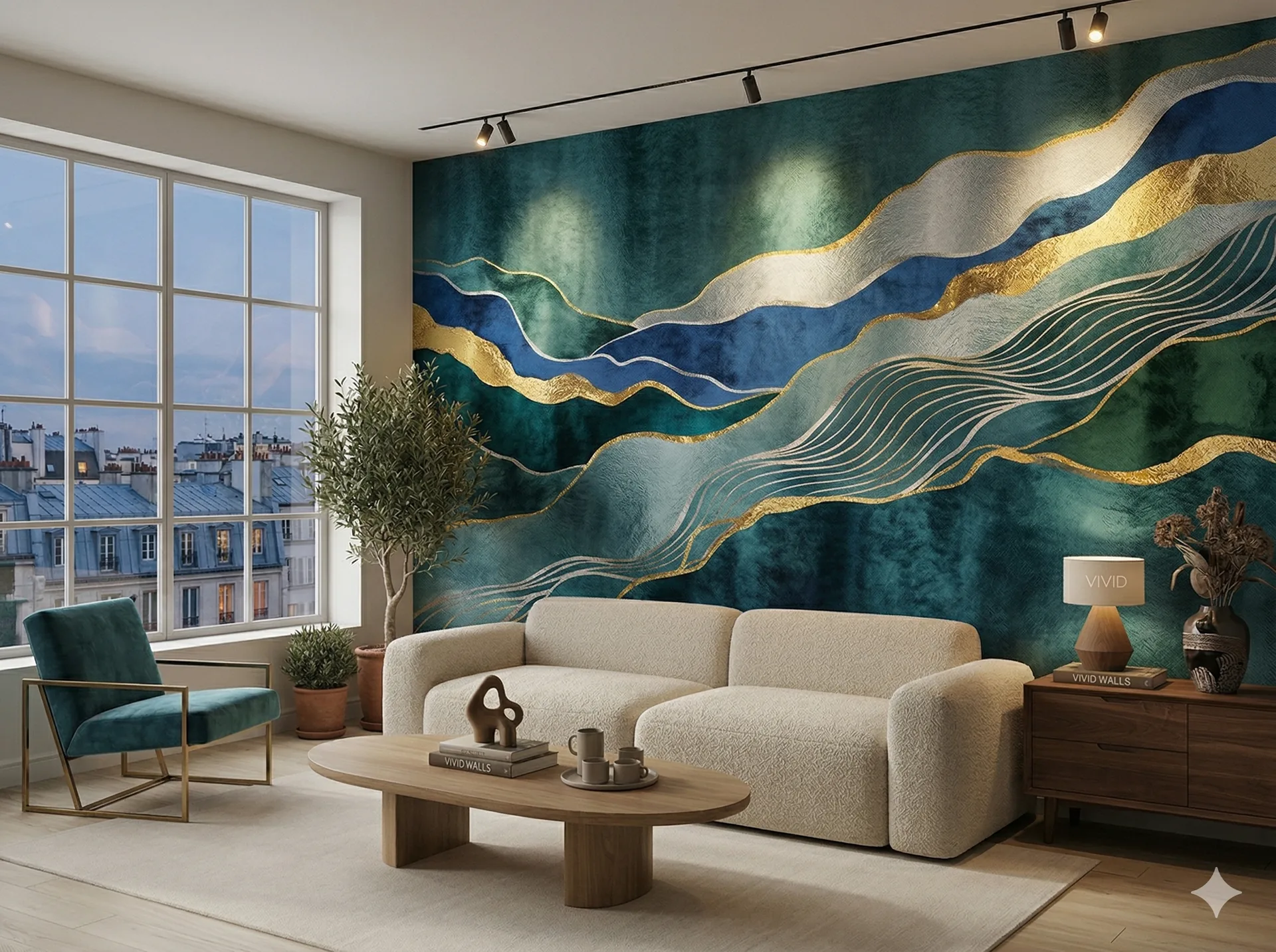
If you have been shopping for wallpaper recently, you have probably noticed the term non-woven appearing on most premium products. But what exactly is non-woven wallpaper, how does it differ from PVC-based materials, and why have interior designers and hoteliers across Europe made it their go-to substrate for feature walls? This guide covers the material itself, the weight classes and textures available, fire certification, and how to install and maintain it — all from the perspective of a manufacturer that has printed it since 2013.
What is non-woven wallpaper?
Non-woven wallpaper is a wall covering made from a blend of natural and synthetic fibres — typically cellulose and polyester — bonded together mechanically or with heat rather than woven on a loom. The bonding process produces a dimensionally stable, tear-resistant backing that does not shrink, stretch, or expand on contact with adhesive. That stability is what separates non-woven from traditional paper-backed wallpaper, which must be soaked, booked, and handled carefully to avoid bubbling. In the VIVID WALLS Nonwoven collection, a printable vinyl surface layer is laminated onto the fleece backing, which is how the material takes both high-resolution print and deep embossed texture. Rolls are produced at 1067 mm width and hung with standard PVA textile adhesive. The result is a substrate that installs faster, sits flatter, and removes more cleanly than any paper-based alternative — the reason it has become the default specification for professional interiors across Europe.
Non-woven vs PVC wallpaper: what is the difference?
The difference comes down to construction and purpose: PVC wallpaper is a thin plastic film with an adhesive backing, while non-woven is a fibre-based textile hung with paste. Our self-adhesive PVC film is monomeric vinyl at 80 µm thickness with a permanent pressure-sensitive adhesive — highly water-resistant and suited to moisture-prone or temporary installations. Non-woven fleece, by contrast, is a breathable 250–450 g/m² material applied with PVA adhesive.
- PVC wallpaper — self-adhesive, glossy by default (matte lamination optional), excellent moisture resistance, available in 1050/1260/1600 mm widths. Common in retail and temporary installations.
- Non-woven wallpaper — paste-the-wall application, breathable, dimensionally stable, matte finish in 12 embossed textures. Preferred for homes, hotels, and permanent interiors.
For permanent residential and commercial installations, non-woven is the professional standard: it does not peel at the seams, it breathes with the wall, and it removes cleanly. For a full decision framework, see our comparison of the two substrates (Self-adhesive vs non-woven wallpaper).
Why interior designers choose non-woven
1. Paste-the-wall application
Paste-the-wall application means the adhesive is rolled onto the wall surface rather than the wallpaper itself — the single biggest practical advantage non-woven holds over paper-backed material. There is no soaking time, no pasting table, and no waiting for the paper to expand before hanging. The installer rolls PVA textile adhesive onto one drop-width of wall, positions the dry sheet against it, and smooths outward from the centre. Because the fleece backing absorbs no water, the sheet stays at its printed dimensions from the first minute to the last — patterns meet where they were designed to meet. On a large commercial job, this cuts installation time substantially: a two-person crew can paper a hotel corridor in a fraction of the time paper-backed material would demand, with far less risk of a mis-timed, over-soaked drop going onto the wall.
2. Dimensional stability
Dimensional stability means the material holds its exact printed size throughout installation and for the life of the wall. Paper-backed wallpaper absorbs moisture from its adhesive, expands as it is hung, then contracts as it dries — the cause of opened seams, misaligned patterns, and bubbles that appear a day after the installer has left. Non-woven’s bonded fleece backing absorbs almost no moisture, so none of that movement happens. Seams stay tight, edge to edge. This matters most on panoramic murals and large-format feature walls, where a printed image runs continuously across several drops: a shift of even two millimetres between drops breaks a landscape horizon or a geometric repeat visibly. It also matters in environments with seasonal humidity swings — hotel spas, coastal properties, poorly ventilated stairwells — where paper-based coverings slowly creep and non-woven simply stays put.
3. Clean removal
Clean removal means non-woven strips off the wall dry, in full sheets, without steamers, scrapers, or chemical removers. Lift a bottom corner and peel steadily upward: the bonded fleece has enough internal strength to come away in one piece rather than delaminating into fragments the way paper does. The plaster or drywall underneath stays intact, usually needing nothing more than a light skim and primer before the next covering goes up. This is precisely why hoteliers and commercial landlords specify it: refurbishment cycles in hospitality run every five to seven years, and stripping a paper-backed corridor is days of labour while stripping non-woven is hours. For interior designers, it also removes the awkward end-of-life conversation with residential clients — the feature wall they commission today will not hold the room hostage when tastes change.
Non-woven wallpaper weights explained
Non-woven wallpaper is specified by weight in grams per square metre, and the weight class determines where the material should be used. The VIVID WALLS Nonwoven collection — vinyl on fleece, washable, M2 fire certified — comes in three classes:
- Standard (250 g/m²) — the core of the range, available in ten embossed textures: Andromeda (smooth, minimal texture), Pyxis (fine matting), Vela (leather effect), Fornax (crumpled paper), Orion (fine diamond mesh), Phoenix (coarse crumpled), Crux (linen), Pictor (fine grain), Sculptor (vertical stripes) and Lacerta (vertical threads). Suited to residential use and lighter commercial projects.
- Heavy (Auriga, 350 g/m²) — a heavy woven texture with increased durability for high-traffic areas such as hotel corridors and hospitality environments.
- No-Scratch (Taurus, 450 g/m²) — a premium scratch-resistant surface for environments needing regular cleaning or contact resistance.
All twelve textures print at 1067 mm roll width and hang with PVA adhesive. Browse the collection at (Designer wallpapers).
Fire ratings: what you need to know
Fire certification is a legal requirement for wall coverings in most EU commercial buildings — hotels, offices, schools, and hospitals cannot specify unrated material. The VIVID WALLS Nonwoven collection carries M2 fire certification, which covers the majority of hospitality and office fit-outs. Where a project specification demands the strictest civilian grades, the HP PVC-Free Wallpaper carries B1 (Germany) and M1 (France) ratings. That material brings additional credentials that matter in sensitive environments: it is odour-free, certified FSC® and CE, and carries GREENGUARD certification for low chemical emissions — the combination that makes it the standard specification for hospitals, schools, and public buildings. It is a 175 g/m² media printed at 1372 mm width. If you are tendering for a commercial project, request the certificates with your quote (request a quote) — compliance documentation ships with every commercial order.
How to install non-woven wallpaper
Installing non-woven wallpaper is a paste-the-wall process that a competent DIYer can complete, though large murals reward professional hands. The five steps:
- 1. Prepare the surface. Walls must be dry, clean, and structurally sound. Prime bare plaster or fresh drywall so it does not draw moisture out of the adhesive. Fill cracks and sand smooth — embossed textures hide minor imperfections, but smooth finishes like Andromeda show everything.
- 2. Apply adhesive to the wall. Use a quality PVA textile adhesive. Roll it evenly onto the area where the first drop will hang, slightly wider than the 1067 mm sheet.
- 3. Hang the first drop. Align it to a plumb vertical line, never to a corner or window frame. Smooth from the centre outward with a soft spatula to push out air.
- 4. Butt-join the seams. Edges touching, never overlapping. Press with a seam roller.
- 5. Trim at ceiling and skirting. Use a sharp craft knife against a straight edge; change blades often.
Is non-woven wallpaper washable?
Yes — the VIVID WALLS Nonwoven collection is washable across all twelve textures and all three weight classes. The vinyl surface layer laminated onto the fleece backing is what makes this possible: it seals the printed image so the wall can be wiped with a damp cloth and mild soap solution without lifting ink or saturating the backing. For most residential settings, an occasional wipe-down handles fingermarks and dust. Where cleaning is a daily operational reality — hotel corridors, restaurant walls, clinic waiting rooms — specify by weight class: the 350 g/m² Auriga tolerates frequent contact, and the 450 g/m² Taurus No-Scratch is built specifically for regular cleaning without marking or burnishing. What non-woven is not is waterproof: it is a breathable interior material, not a splash-zone surface. For walls with direct water exposure, self-adhesive PVC film is the correct substrate (Self-adhesive vs non-woven wallpaper).
Conclusion
Non-woven wallpaper is the right choice for almost any permanent interior installation where quality, installation ease, and longevity matter. It performs better at every stage of its life: faster to hang, dimensionally stable on the wall, washable in service, and removable in clean, dry sheets at the end. With twelve textures across 250, 350, and 450 g/m² weight classes and M2 fire certification as standard, the VIVID WALLS Nonwoven collection covers everything from a single bedroom feature wall to a full hotel refurbishment. For design direction, start with our feature wall ideas (Feature wall wallpaper ideas); for the material itself, explore the collection (Designer wallpapers) or place a custom-printed order in the exact dimensions of your wall (request a quote).
Frequently asked questions
Is non-woven wallpaper suitable for bathrooms and kitchens?
Non-woven suits kitchens and guest bathrooms away from direct water contact — it is washable and breathable, but not waterproof. For splash zones, high-steam bathrooms, or surfaces that are regularly wetted, specify self-adhesive PVC film instead, which is water-resistant and wipeable by construction.
What adhesive does non-woven wallpaper need?
Non-woven wallpaper hangs with standard PVA textile adhesive, applied to the wall rather than the sheet. No soaking or booking is required. Use a quality ready-mixed or powder PVA rated for non-woven or fleece wallpapers, and roll it evenly one drop-width at a time.
How wide are non-woven wallpaper rolls?
All VIVID WALLS non-woven textures are produced at 1067 mm roll width, printed to the exact height of your wall. Custom murals are supplied as numbered drops sized to your dimensions, so a typical residential feature wall needs three to four drops with butt-joined seams.
Can non-woven wallpaper be used in hotels and public buildings?
Yes — this is its core commercial application. The Nonwoven collection is M2 fire certified, and the 350 g/m² and 450 g/m² weight classes are specified for high-traffic hospitality corridors. Where B1/M1 ratings or GREENGUARD low-emission certification are required, the HP PVC-Free Wallpaper meets those specifications.
How long does custom-printed non-woven wallpaper take to produce?
Every order is printed to measure at our production facility in Sofia, Bulgaria, and shipped EU-wide. Because we manufacture in-house rather than reselling, custom dimensions do not add lead time — send your wall measurements with your enquiry (request a quote) and we confirm production and delivery dates with the quote.